For everyone who loves octopuses
Protect the reefs octopuses call home
The big blue octopus makes its home in dens on coral reefs. Reefs need clear water, and mud washing off the land can smother coral and block its light. Mangroves help hold the shore together, and they can help trap some of that mud before it reaches the reef. At least one kind of octopus has been found living in mangrove waters, and mangroves shelter the kinds of crabs, prawns and young fish that octopuses eat. Here is what the research shows, and what it does not.
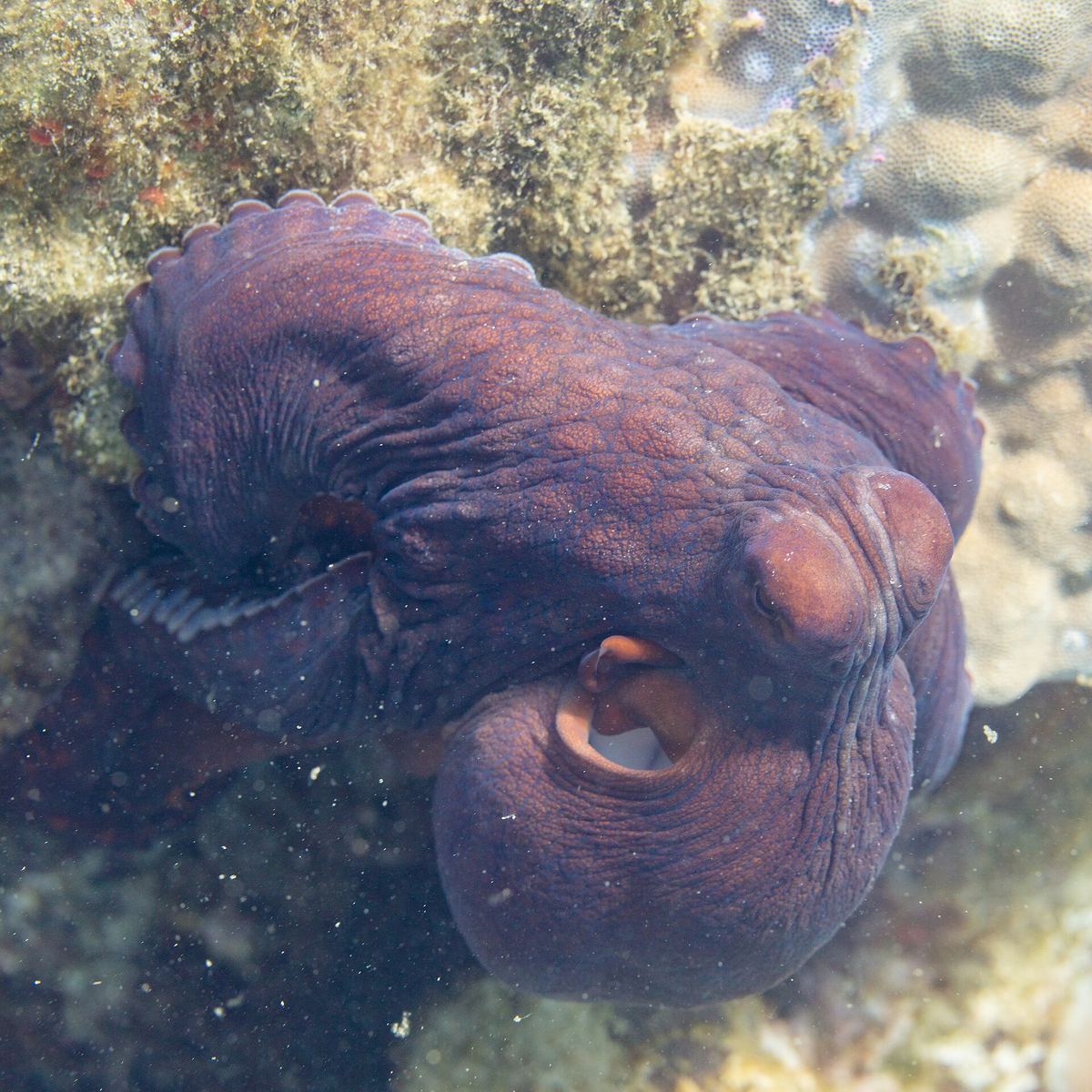
- 177 times an hour, on average, octopuses hunting on coral reefs changed their colour and pattern
- Over 30% of Indian Ocean reefs rated threatened by polluted runoff from the land
- 30% to 65% of incoming sediment kept by even degraded mangroves in a creek on Kenya's coast
- 6,608 ha of Tanzania's mangroves lost between 1996 and 2020, leaving 110,787 hectares
Where these numbers come from. Each figure is from published research, listed in full under Sources. They are not counts we made ourselves. Our own counts are on the plot 01 evidence.
Meet the big blue octopus
A clever, shy animal with a reef for a home
The big blue octopus, also called the day octopus, lives on coral reefs across the Indo-Pacific. Roger Hanlon, a senior scientist at the Marine Biological Laboratory who studies colour change in octopuses, squid and cuttlefish, calls it "one of the most interesting and sophisticated octopus species on the planet", and one of the hardest to study because it is wary, wily and shy.5
On Lizard Island, on Australia's Great Barrier Reef, researchers found it living in dens in the coral rock and describe it moving to a new one every few days to several weeks. One den there had a pile of leftover shells and crustacean parts at its door, and an octopus can sit in a "lookout" pose with its eyes raised above the entrance to watch the reef.6
It is a master of disguise. Octopuses filmed hunting on reefs in Tahiti and Palau, identified by later studies as big blue octopuses, changed their colour and pattern 177 times an hour on average, most often to camouflage themselves against each new kind of seabed as they crawled slowly across it.1 When a crab hides, the octopus can ripple dark shadows over its body like a passing cloud, which scientists think startles the crab into moving.7 In the Red Sea it even hunts in groups with fish, especially goatfish.8 On the reefs of Moorea, in French Polynesia, the leftovers of its meals showed 64 different kinds of prey, from clams to crabs and sea snails, and its diet was more varied where the seabed was more varied.9
It lives fast: its lifespan appears to be only 12 to 15 months.10 Its dens and its hunting grounds are on the reef, so the health of the reef is the health of its home.
Octopuses and mangroves
Do octopuses live in mangroves?
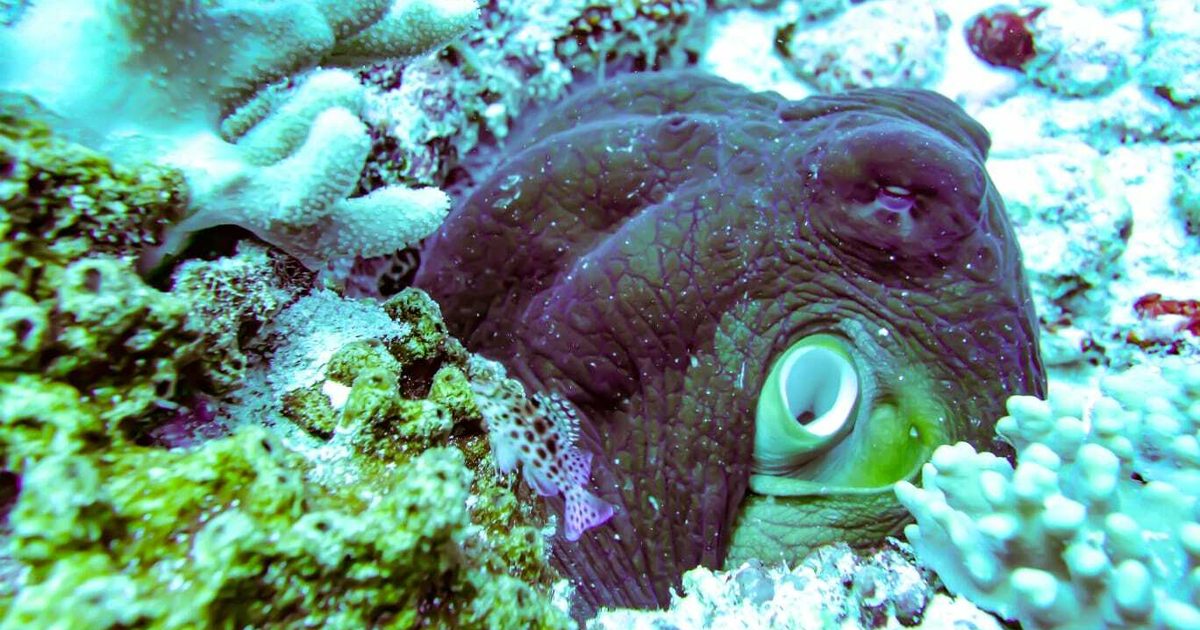
At least one kind has been found living in mangrove waters. The big blue octopus is a reef animal, and we found no study of it living among mangrove roots. But mangroves shelter crabs, prawns and young fish, the kinds of animals octopuses eat.
A home for pouched octopuses
In June 2022, scientists in West Bengal, India found five young pouched octopuses (Cistopus platinoidus) about 75 km up the Hooghly-Matlah estuary from the sea. The site is lined with dense mangroves, and its muddy bottom is mixed with broken-down mangrove leaves. The researchers think this octopus has settled into these mangrove waters, and that the mangroves, with plenty of prey and good conditions, may support nursery grounds for young octopuses. That has not been tested yet.21
Food for octopuses
Octopuses that live on the seabed often hunt crabs, prawns and small fish,21 and the big blue octopus also eats clams and sea snails.9 Mangroves give animals like these plenty of food and shelter with few predators, and a major review says they may act as nurseries for crabs, prawns and fish.22 Around the Indian estuary, the pouched octopuses shared the water with crabs, prawns and small bottom-living fish.21 On Inhaca Island, Mozambique, Indian white prawns were more common along the mangrove edge than on the bare sand next to it.24 A 2025 global study estimates that mangroves support over 700 billion young fish and prawns, plus crabs and cockles, each year, counting only 37 species. Its margin of error is wide.23
We found no study showing that the crabs the big blue octopus eats on the reef grew up in mangroves. For the big blue octopus, the link we found runs through its reef: mangroves can help trap some of the mud that harms coral, as the next sections explain.
Why its reef needs clear water
Mud is hard on coral
Corals are animals that farm. Tiny algae living inside them make food from sunlight, so corals need light and clear water.11
It blocks the light
Cloudy water cuts the sunlight that corals rely on for food.13
Experts expect reefs exposed to runoff from the land to take longer to recover from storms and coral bleaching.11 A 2011 global model rated more than 30% of reefs in the Indian Ocean region as threatened by polluted runoff, mostly from heavily farmed parts of coastal East Africa and Madagascar.2 We found no study of how mud affects the big blue octopus itself. What is well studied is what mud does to the corals that build its home.
How mangroves help
Two jobs mangroves do on the coast
The first protects the shore from erosion. The second, trapping some of the mud that washes off the land, is the one that can help reefs.
1. Holding the shore together
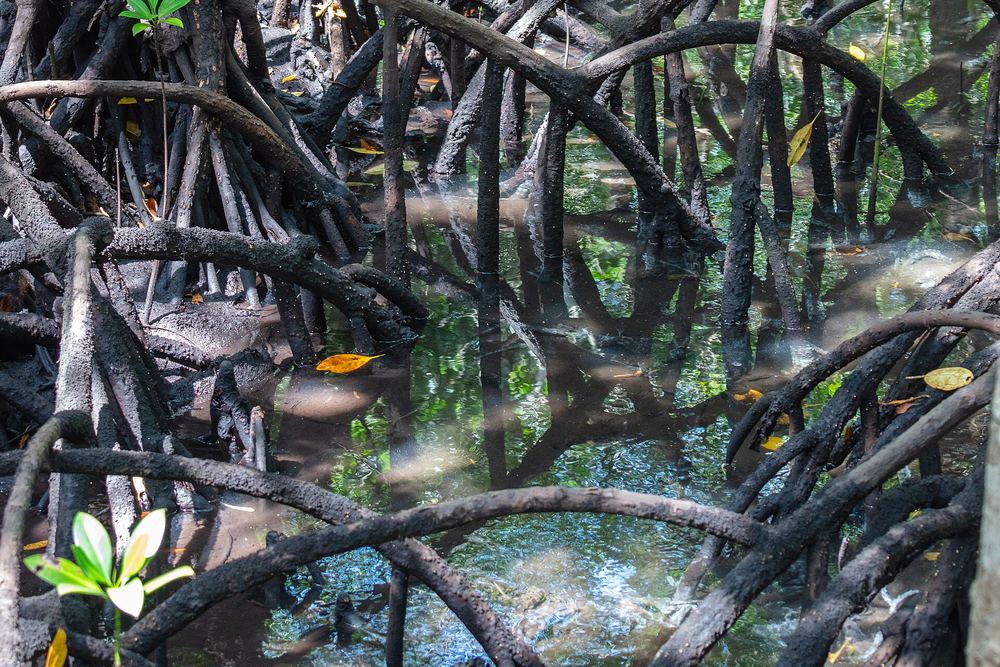
Mangrove roots help hold the soil together and slow the water, so mud settles instead of washing away, and where mangroves grow they generally reduce erosion.14 In field studies, everyday waves were 13% to 66% smaller after passing through 100 metres of mangroves.15 Where mangroves were cleared for aquaculture ponds and farms, as in the Gulf of Thailand, northern Java and Guyana, shores that were stable or growing now retreat by many metres a year. Draining the cleared land also makes it sink, and other causes play a part too.14
This protects the coast itself. We found no research showing that it helps reefs.
2. Trapping some of the mud before it reaches the reef
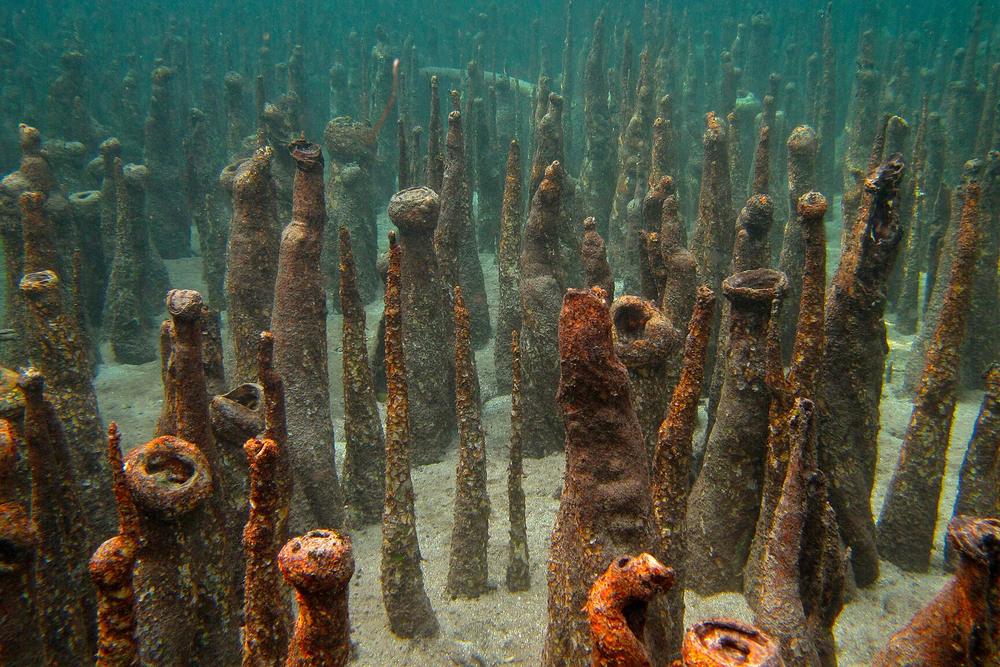
Where mangroves lie between rivers and reefs, mud settles out in the calm water among their roots, so they can help trap it before it reaches the reef.2 In two estuaries in Palau, mangroves covering under 4% of the land each river drains trapped about 30% of the fine mud the rivers carried down.16 Across published studies, mangrove forests kept anywhere from 1% to 90% of the incoming mud, and bigger forests kept a bigger share.17
What we know, and what we do not
Mangroves trap some of the mud, not all of it. In Airai Bay, Palau, only 15% to 30% of the river mud settled in the mangroves during floods, mud left in the bay is smothering reefs there, and the authors warn that the bay's marine life may not last without better control of soil erosion upstream.18 Planting is not a cure-all either: in Gujarat, India, a large mangrove planting did not reduce erosion, and local geography appeared to matter most.19
We found no study that compared the mud on a reef with and without mangroves, or that measured what mangroves mean for octopus numbers. So we do not claim that planting mangroves saves octopuses. We claim something smaller and well supported: at least one kind of octopus has been found in mangrove waters, mangroves shelter the kinds of animals octopuses eat, and they help hold the shore together and can help trap some of the mud that harms the reefs octopuses live on.
Where your gift goes
Mangroves going back into Tanzania's coast
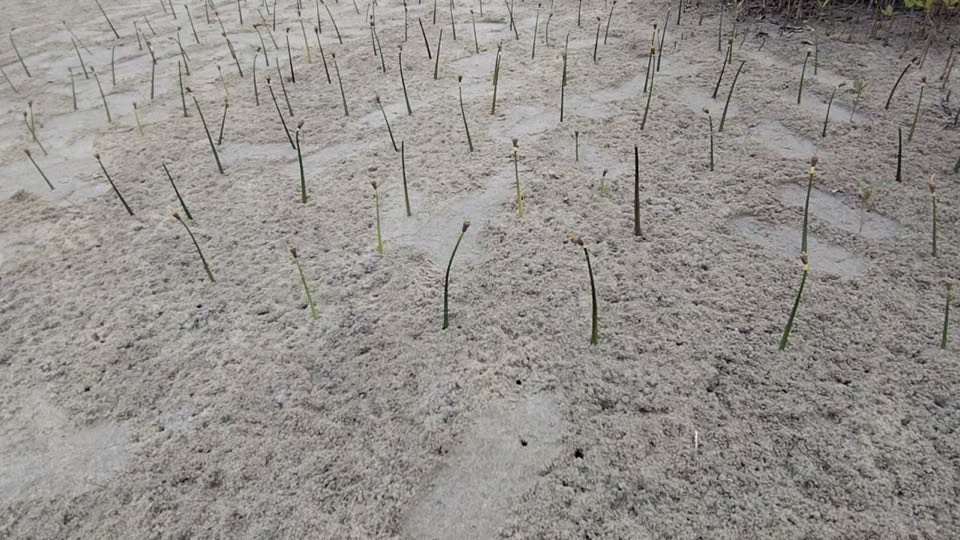
Tanzania had 110,787 hectares of mangroves in 2020, 6,608 fewer than in 1996.4 Worldwide, half of the mangrove ecosystems assessed are at risk of collapse.20 Treegens Foundation supports batch mangrove planting along Tanzania's coast and publishes plot-level video, GPS coordinates and counts, so you can inspect the planting yourself. Young mangroves need time to grow before they can do either job, and we do not claim that any one plot protects a particular reef.
$0.10 is the stated average planting cost per mangrove across a batch. It is not a per-tree sale or donor-specific allocation, and we do not claim a survival rate.
For octopus lovers
Help protect the reefs octopuses call home
Give once or monthly to support future batch mangrove planting along Tanzania's coast. $0.10 is the stated average planting cost per mangrove.
Mangrove numbers use the stated average planting cost, not a donor-specific tree allocation. Stripe's card processing fee comes out of the gift; nothing extra is charged to you and no tip is asked.
Secure donations powered by Stripe
Do not rely on this site for tax deductibility. Use the receipt or payment record from Stripe, and consult your adviser if needed.
Choose your gift
One-time gift
Monthly gift. Change or cancel anytime.
Secure checkout by Stripe: card, Apple Pay, Google Pay and Link. You pay on Stripe's page and come straight back here.
Fees: Stripe's card processing fee comes out of the gift. Nothing extra is charged to you and no tip is asked.
Sources
Where every fact comes from
Checked in October 2026 against the published papers and reports, or against their abstracts where the full text was not open.
- Hanlon, R. T., Forsythe, J. W. & Joneschild, D. E. (1999). Crypsis, conspicuousness, mimicry and polyphenism as antipredator defences of foraging octopuses on Indo-Pacific coral reefs, with a method of quantifying crypsis from video tapes. Biological Journal of the Linnean Society 66(1): 1-22. doi.org/10.1111/j.1095-8312.1999.tb01914.x
- Burke, L., Reytar, K., Spalding, M. & Perry, A. (2011). Reefs at Risk Revisited. World Resources Institute, Washington, DC. wri.org
- Kitheka, J. U., Ongwenyi, G. S. & Mavuti, K. M. (2002). Dynamics of suspended sediment exchange and transport in a degraded mangrove creek in Kenya. Ambio 31(7): 580-587. repository.seku.ac.ke
- Wetlands International and Save Our Mangroves Now! (2022). The State of Mangroves in the Western Indian Ocean, Tanzania chapter (Global Mangrove Watch data). wetlands.org
- Knight, K. (2021). In the field: an interview with Roger Hanlon. Journal of Experimental Biology 224(24): jeb243831. doi.org/10.1242/jeb.243831
- Roper, C. F. E. & Hochberg, F. G. (1988). Behavior and systematics of cephalopods from Lizard Island, Australia, based on color and body patterns. Malacologia 29(1): 153-193. archive.org
- Mather, J. A. & Mather, D. L. (2004). Apparent movement in a visual display: the "passing cloud" of Octopus cyanea (Mollusca: Cephalopoda). Journal of Zoology 263(1): 89-94. doi.org/10.1017/S0952836904004911
- Sampaio, E., Sridhar, V. H., Francisco, F. A., Nagy, M. et al. (2024). Multidimensional social influence drives leadership and composition-dependent success in octopus-fish hunting groups. Nature Ecology & Evolution 8(11): 2072-2084. doi.org/10.1038/s41559-024-02525-2
- Scheel, D., Leite, T., Mather, J. & Langford, K. (2017). Diversity in the diet of the predator Octopus cyanea in the coral reef system of Moorea, French Polynesia. Journal of Natural History 51(43-44): 2615-2633. doi.org/10.1080/00222933.2016.1244298
- Van Heukelem, W. F. (1973). Growth and life-span of Octopus cyanea (Mollusca: Cephalopoda). Journal of Zoology 169(3): 299-315. doi.org/10.1111/j.1469-7998.1973.tb04559.x
- International Society for Reef Studies (2004). The effects of terrestrial runoff of sediments, nutrients and other pollutants on coral reefs. ISRS Briefing Paper 3. coralreefs.org (PDF)
- Erftemeijer, P. L. A., Riegl, B., Hoeksema, B. W. & Todd, P. A. (2012). Environmental impacts of dredging and other sediment disturbances on corals: a review. Marine Pollution Bulletin 64(9): 1737-1765. doi.org/10.1016/j.marpolbul.2012.05.008
- Rogers, C. S. (1990). Responses of coral reefs and reef organisms to sedimentation. Marine Ecology Progress Series 62: 185-202. doi.org/10.3354/meps062185
- Spalding, M., McIvor, A., Tonneijck, F. H., Tol, S. & van Eijk, P. (2014). Mangroves for coastal defence: guidelines for coastal managers and policy makers. Wetlands International and The Nature Conservancy. nature.org (PDF)
- McIvor, A. L., Möller, I., Spencer, T. & Spalding, M. (2012). Reduction of wind and swell waves by mangroves. Natural Coastal Protection Series, Report 1. The Nature Conservancy and Wetlands International. library.sprep.org (PDF)
- Victor, S., Golbuu, Y., Wolanski, E. & Richmond, R. H. (2004). Fine sediment trapping in two mangrove-fringed estuaries exposed to contrasting land-use intensity, Palau, Micronesia. Wetlands Ecology and Management 12(4): 277-283. doi.org/10.1007/s11273-005-8319-1
- Gillis, L. G., Bouma, T. J., Jones, C. G., van Katwijk, M. M. et al. (2014). Potential for landscape-scale positive interactions among tropical marine ecosystems. Marine Ecology Progress Series 503: 289-303. int-res.com (PDF)
- Golbuu, Y., Victor, S., Wolanski, E. & Richmond, R. H. (2003). Trapping of fine sediment in a semi-enclosed bay, Palau, Micronesia. Estuarine, Coastal and Shelf Science 57(5-6): 941-949. doi.org/10.1016/S0272-7714(02)00424-9
- Das, S. (2020). Does mangrove plantation reduce coastal erosion? Assessment from the west coast of India. Regional Environmental Change 20(2): 58. doi.org/10.1007/s10113-020-01637-2
- IUCN (2024). More than half of all mangrove ecosystems at risk of collapse by 2050, first global assessment. iucn.org
- Bhakta, D., Manna, R. K., Das, B. K., Nair, S. M. & Samanta, S. (2024). First report of Cistopus platinoidus Sreeja, Norman & Biju Kumar, 2015 (Cephalopoda, Octopoda, Octopodidae) from the tropical Hooghly-Matlah estuary, West Bengal, India. Indian Journal of Geo-Marine Sciences 53(07): 518-525. doi.org/10.56042/ijms.v53i07.11854
- Nagelkerken, I., Blaber, S., Bouillon, S., Green, P. et al. (2008). The habitat function of mangroves for terrestrial and marine fauna: a review. Aquatic Botany 89(2): 155-185. doi.org/10.1016/j.aquabot.2007.12.007
- zu Ermgassen, P. S. E., Worthington, T. A., Gair, J. R., Garnett, E. E. et al. (2025). Mangroves support an estimated annual abundance of over 700 billion juvenile fish and invertebrates. Communications Earth & Environment 6: 299. doi.org/10.1038/s43247-025-02229-w
- Rönnbäck, P., Macia, A., Almqvist, G., Schultz, L. & Troell, M. (2002). Do penaeid shrimps have a preference for mangrove habitats? Distribution pattern analysis on Inhaca Island, Mozambique. Estuarine, Coastal and Shelf Science 55(3): 427-436. doi.org/10.1006/ecss.2001.0916
Photos
Photos were cropped and resized for this page. Each keeps its original licence.
- Big blue octopus, Nosy Tanikely, Madagascar: Diego Delso, delso.photo, License CC BY-SA 4.0, via Wikimedia Commons
- Big blue octopus off northern Zanzibar: Luke Lythgoe, CC BY 4.0, via iNaturalist
- Mangrove roots, Jozani Chwaka Bay National Park, Zanzibar: Diego Delso, delso.photo, License CC BY-SA 4.0, via Wikimedia Commons
- Mangrove breathing roots underwater, Sulawesi, Indonesia: Bernard Dupont, CC BY-SA 2.0, via Wikimedia Commons
- Plot 01, Dar es Salaam coast: Treegens Foundation.
Help protect the reefs octopuses call home.
Every $10 supports 100 mangroves at the stated average planting cost.
Plant mangroves for the reef →